Domestic Policy Options for the Oil Price Shock
This article examines the domestic policy options available in the context of an oil price shock, assessing fiscal and structural measures to mitigate the economic impact on Romania.
By Laurian Lungu, Co-founder of Consilium Policy Advisors Group
The blockade of the Strait of Hormuz has led to an increase in the price of oil by more than 50% in recent days. However, today, when oil is traded around 100 USD/barrel, it is cheaper, in real terms (i.e. taking into account the evolution of inflation), by almost a third of the average for the period 2008–2014. Also in real terms, the price at the pump is higher due to the significant increase in excise duty levels. At the moment, the current price of oil does not fully incorporate a series of other risks, the cumulative effect of which could take the cost of a barrel of oil, in real terms, beyond the values reached in that period. In nominal terms, the equivalent of the then price of Brent oil would mean somewhere around $150/barrel today.
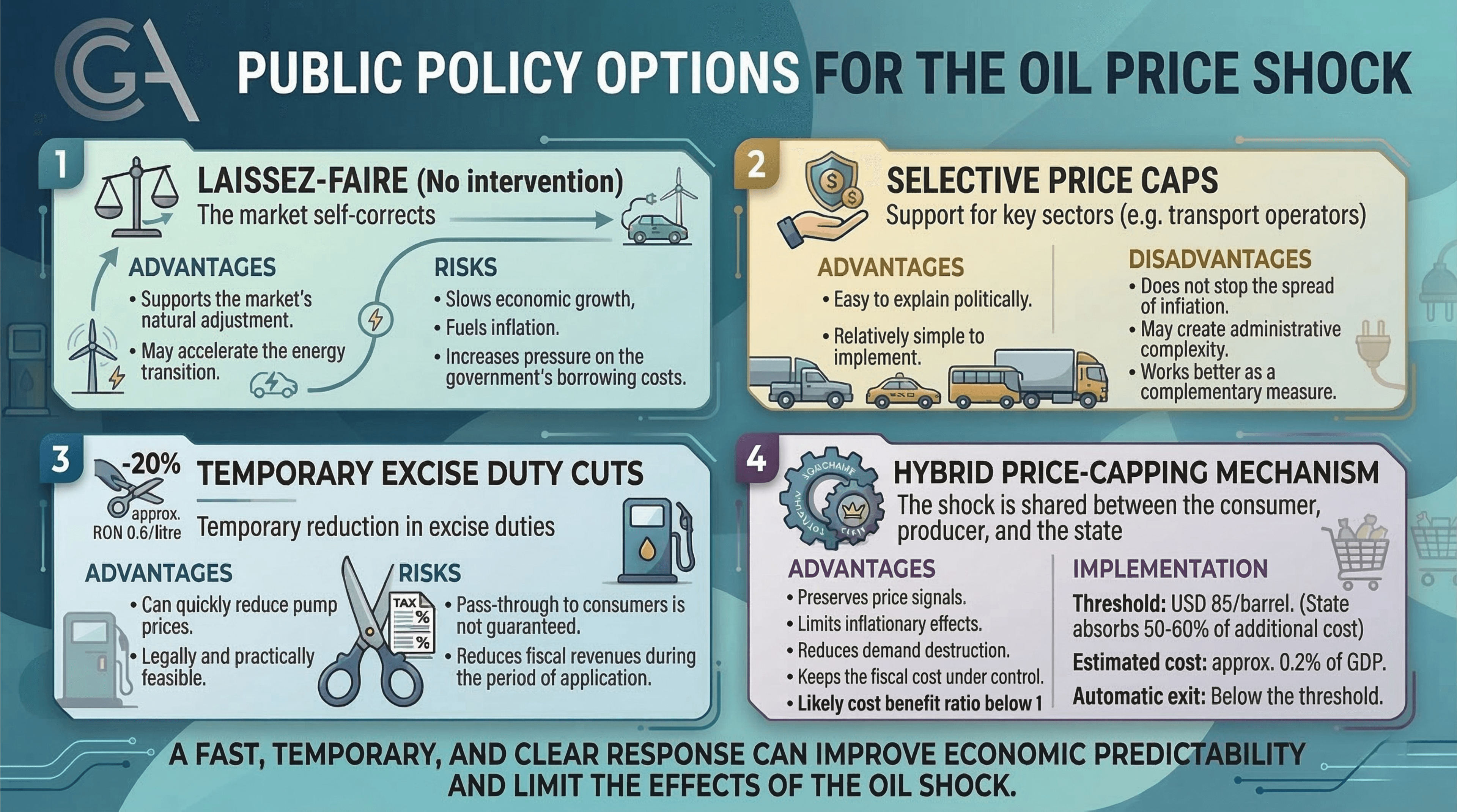
There are several alternative responses of the Romanian authorities in reaction to this oil price shock. They must balance both elements related to the external and internal contexts, especially those related to the continuation of corrections of macroeconomic imbalances. A first alternative is to do nothing, to let the market correct itself. This, however, in the short term, would slow economic growth and accelerate inflation, putting pressure on the state's borrowing cost. In the last month alone, government bond yields have risen by 100 basis points over time horizons exceeding 4 years. Thus, an oil price shock that can be essentially transitory, can generate a deterioration in demand that will take a longer time to recover later. In addition, it would push up inflationary expectations, already elevated by the increase in VAT, excise duties, or the increase in the minimum wage. An advantage — in the medium and long term — of this strategy is the acceleration of the transition to electrification or other alternative technologies.
Another alternative could be the introduction of selective price caps for certain sectors, such as transport operators. The Government has already advanced in this direction by granting a subsidy of 0.85 RON/liter of diesel. This is politically understandable and administratively manageable. But, as an independent response, it is inadequate. The main problem is that selective support for carriers does not prevent the wider inflationary spillover of high fuel prices across all goods and services. The scheme is prone to leakage and administrative complexity in determining eligible volumes, especially for operators combining commercial and non-commercial use. Selective caps work best as a complement to a broader pricing mechanism, not as a substitute.
Another variant circulated aims at temporary reductions in excise duties. The authorities have already signaled that the reduction of excise duties is actively considered, noting that a temporary reduction is legally and practically feasible. On paper, the fiscal arithmetic is attractive: for example, the current excise duty on gasoline, of 3,059.80 RON/1,000 liters, translates into about 3.06 RON/liter; reducing it by 20% would reduce pump prices by about 0.6 RON/liter, an important decrease. However, the reduction of the tax ceiling could be absorbed at the margin of producers and distributors. There is no guarantee that the reduction in excise duties will be fully reflected in the decrease in the price at the pump. International evidence from the 2022 energy crisis — when France, Germany and several other EU states temporarily cut fuel taxes — shows mixed transfer rates, with retailers absorbing a significant share as a margin. A reduction in excise duties also permanently erodes revenues for the duration of application, regardless of market behaviour.
Another alternative is to introduce, exceptionally, a temporary mechanism for capping prices at the pump through a hybrid price cap system that shares the shock between consumers, producers and the state - instead of transferring it entirely to one party. The government could set a maximum indicative price at the pump, calibrated to a crude oil reference level – perhaps somewhere around $85 a barrel – representing a reasonable middle ground between the pre-conflict environment and the current extreme. At 65 USD/barrel, the budgetary arithmetic of the structure of excise duties in Romania has been broadly calibrated; at $85/barrel, a modest additional pass-through to consumers is reasonable given the global nature of the shock. Above this threshold, the authorities absorb a defined quota – i.e. 50-60% of the additional cost per liter – the rest being transferred to consumers.
This mechanism maintains price signals – as opposed to a total freeze – prevents severe demand destruction, second-round inflation and price and wage pressures that would accompany an uncapped price propagation beyond $100/barrel, and limits fiscal exposure to an affordable and limited subsidy package. It also avoids the regressive policy of energy poverty: at over RON 9 per liter of diesel, the cost impact on logistics, agriculture and low-income households threatens to generate generalized inflationary pressure, far beyond the transport sector - increasing borrowing costs just when Romania's fiscal position cannot afford monetary tightening. A price cap at, for example, RON 8.50 for diesel, with the government covering the difference above this level at current market prices, would have a fiscal cost of about RON 4 billion for a full year of crude oil at $100, or about 0.20% of GDP.
Meaningful, but manageable and explicit temporarily. By balancing the benefits of both less severe demand destruction – and thus greater protection of forecasted tax revenues, and anchoring inflationary expectations and thus potentially the benefit of lower government borrowing costs, they are very likely to offset the fiscal cost. Crucially, this mechanism should be designed with an automatic exit trigger: once the price of Brent falls sustainably below $85/barrel, the capping mechanism closes. This prevents the trap of the political economy of subsidies from becoming permanent.
As each day of conflict passes, the probability that the price of oil will remain at high levels for a longer period of time is increasing. Quickly adopting a clear strategy to respond to this shock would help the economy navigate the immediate period ahead more predictably.